
Aprilaire Air Duct Cleaning in Valley Hi: A Homeowner’s Guide
Aprilaire air duct cleaning in Valley Hi is not a different process from standard duct cleaning, but it does demand extra care around the Aprilaire equipment itself. A whole-home purifier or humidifier attached to your ductwork changes what a technician must check, protect, and verify before and after the cleaning. Done correctly, cleaning extends the life of your Aprilaire system. Done carelessly, it can clog a media filter, throw off airflow balance, or leave sensor contacts coated in dust. If you’d rather skip the research and get a straight answer about your system, call us at (833) 399-2759.
Why Aprilaire Systems Change the Duct Cleaning Conversation
Most Valley Hi homes with an Aprilaire system have one of two configurations: a media filter cabinet mounted at the return side, or a bypass humidifier tapped into the supply and return plenums. Some homes run both. The distinction matters because a generic duct cleaning crew treats every house the same: cover the registers, run the vacuum, pack up. We’ve followed behind those jobs and found Aprilaire filter housings coated in the same dust the crew was supposed to remove.
Here’s the thing about Aprilaire equipment: it’s engineered to specific airflow tolerances. The Model 2410 media filter, for instance, is designed for a maximum face velocity. If the ductwork feeding it is clogged with years of Valley Hi dust, that velocity increases and filtration efficiency drops. You’re not just breathing dirtier air; you’re forcing the blower to work harder than it should. In our experience with air duct cleaning in Valley Hi, a surprising number of “failing” Aprilaire systems simply had blocked return trunks upstream of the filter.
What the Technician Should Check Before Any Cleaning Starts
A proper duct cleaning on an Aprilaire-equipped system begins with a ten-minute inspection, not a vacuum hose. If the crew that shows up doesn’t ask where your filter cabinet or humidifier is located, that’s a red flag. Here’s what a qualified technician evaluates first:
- Filter condition and position: Is the media filter seated correctly? An unseated filter lets dirty air bypass it entirely, which means the coil and supply ducts downstream are far dirtier than they should be.
- Humidifier damper setting: Bypass humidifiers have a seasonal damper. In Valley Hi, homeowners often leave the damper open year-round, pumping hot summer air through a dry water panel and blowing mineral dust into the ductwork.
- Sensor and control wiring: Aprilaire digital controllers and outdoor temperature sensors have small contact points. Aggressive brushing near them can damage connections, and a powered blower can push fine debris into the control housing.
- Access point locations: Older Valley Hi homes, particularly those built in the 1980s and 1990s, often lack dedicated duct access panels. Cleaning through register openings only reaches a fraction of the system. A proper job requires cutting access near the plenum and capping it afterward.
We run this inspection on every Aprilaire home we service, because cleaning a duct without knowing what it feeds is just moving dirt around.
The Correct Cleaning Sequence for Aprilaire-Equipped Ductwork
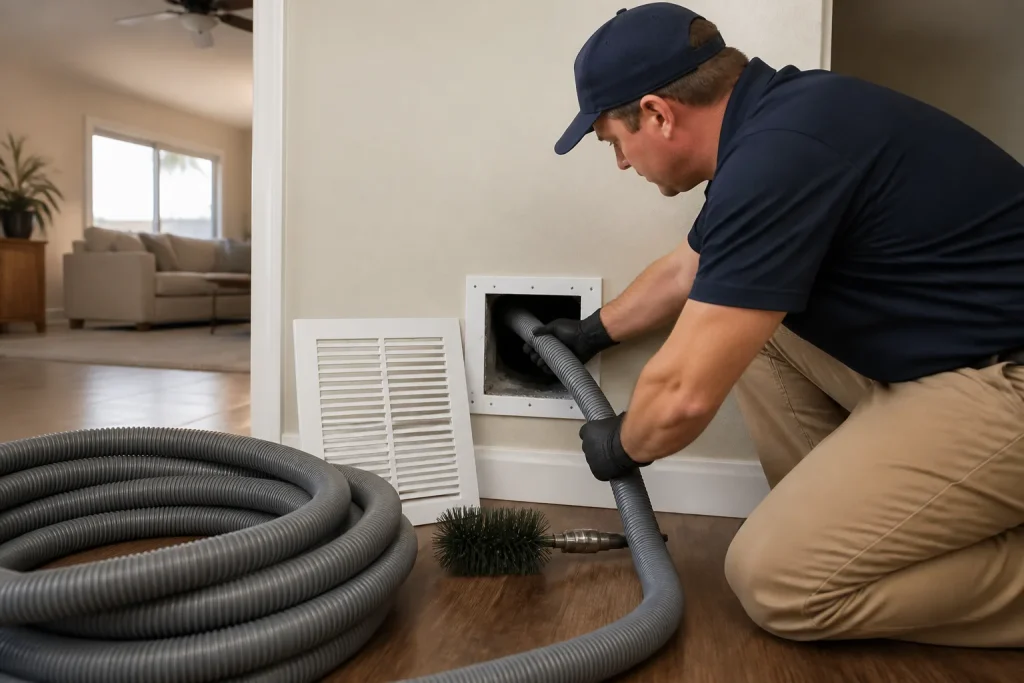
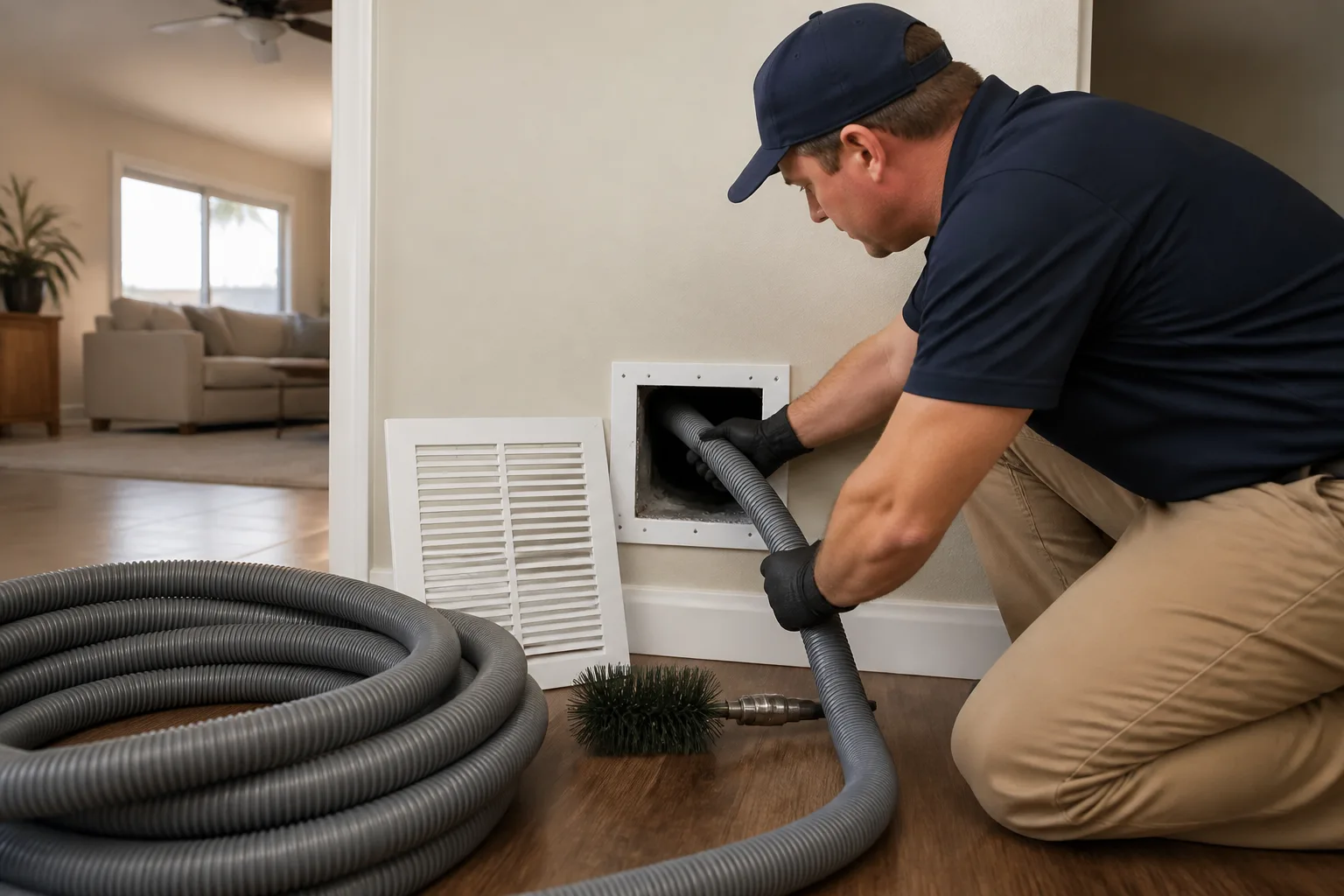
Order matters. If a crew hooks up a high-suction vacuum and starts agitating the supply side first, they can pull debris backward through the return and directly into the Aprilaire media filter. That filter now needs replacing, and the homeowner pays for a mistake they didn’t make. We use Rotobrush and Nikro systems, and the sequence we follow protects every component:
- Remove and bag the Aprilaire media filter. We don’t clean around it; we take it out and set it aside in a sealed bag. If it’s near end-of-life, we note that for replacement; we don’t destroy it mid-job.
- Mask off humidifier bypass ducts at the plenum connection. This prevents dislodged dust from entering the humidifier cabinet and coating the water panel or solenoid valve.
- Clean the return side first, moving toward the filter housing. With Abatement Technologies negative-air containment running, the return trunk is cleaned systematically so dust moves toward the vacuum, not toward the Aprilaire components.
- Clean the supply side, moving away from the plenum. This pushes any remaining debris downstream and out through register openings, again under negative air.
- Wipe down the Aprilaire exterior surfaces and reinstall the filter. The cabinet itself gets a quick clean; pressure switch tubing and drain lines get a visual check.
- Confirm airflow at each register. A smoke pencil or anemometer reading at several registers catches any blockages introduced or revealed by the cleaning.
This sequence is exactly what separates professional-grade work from the shop-vac specials that plague this industry. The equipment brands we run, Rotobrush and Nikro primarily, are what certified IAQ contractors specify. They aren’t consumer tools with a logo slapped on the side.
Valley Hi’s Specific Dust and Humidity Challenges
Valley Hi sits in a part of Sacramento County where summer temperatures regularly clear 95 degrees, and the surrounding agricultural land and open fields generate fine particulate that finds its way into every return register. We’ve pulled filters out of Valley Hi homes in August that looked like they’d been rolled in potting soil. That dust load has a direct relationship to Aprilaire system performance.
During the summer, dust infiltration is highest. Windows are sealed, the AC runs constantly, and the return side of the duct system is under continuous negative pressure. Every small leak in a return trunk becomes a dust intake. That dirt collects on the evaporator coil, reducing heat exchange, and loads the Aprilaire media filter far faster than the manufacturer’s typical replacement interval suggests. In Valley Hi, Aprilaire MERV 16 filters that might last 12 months in a coastal climate often need replacement in 6 to 8 months.
Winter presents the opposite challenge. Sacramento Valley winters are damp but not humid enough for comfort inside a heated home. Aprilaire bypass humidifiers run frequently in December and January, and any mineral buildup or dust inside the humidifier cabinet gets distributed through the supply ducts. If the ducts haven’t been cleaned, that moisture combines with existing dust to form a film on duct walls. That film then bakes on during the next summer’s heat, making future cleaning more difficult. A clean duct system handles seasonal humidity swings far better than a dirty one.
Questions to Ask Any Duct Cleaner About Your Aprilaire System
You don’t need to become an HVAC technician to protect your equipment. You just need to ask the right questions before scheduling. Here’s what we recommend every Valley Hi homeowner with Aprilaire gear ask:
- “How will you protect my Aprilaire filter during cleaning?” If they say they’ll “work around it,” find someone else. The correct answer involves removal, bagging, or both.
- “Do you check the humidifier bypass before you start?” A technician who doesn’t mention the bypass damper or water panel is not thinking about integrated IAQ systems.
- “What equipment do you actually run?” Listen for Rotobrush, Nikro, or Abatement Technologies. These are the professional-grade names. If they can’t name their equipment, it’s probably a truck-mounted shop vac.
- “Will you verify airflow after the job?” Post-cleaning verification is not optional on Aprilaire systems. Airflow balance affects filter efficiency and humidifier distribution.
- “What does your before-and-after documentation look like?” You should see photos of your own ducts, including the Aprilaire components. No photos means no accountability.
These questions take two minutes to ask and save you from the $49 coupon trap where a crew shows up, runs a vacuum for 45 minutes, and leaves your Aprilaire filter clogged with debris they dislodged but never contained. We use negative-air containment on every job precisely because what comes out of your ducts should stay out of your living space.
Post-Cleaning Verification Steps for Aprilaire Setups
When the crew is packing up, the job isn’t done. Here’s what a thorough post-cleaning protocol looks like on an Aprilaire home, and what we run through before we leave a Valley Hi property:
- Airflow confirmation at every register. This isn’t just a hand-wave test. We check supply and return registers with an anemometer and compare readings. A significant drop at one register suggests a loose connection or debris blockage introduced during cleaning.
- Filter inspection timing. Reinstall the Aprilaire media filter and note its condition. If the cleaning was thorough, the filter should be no dirtier than when it was removed. If it’s visibly loaded with new debris, the containment protocol failed and the job should be redone.
- Humidifier function check. For bypass units, confirm the damper is set for the current season and the water panel isn’t clogged with loosened dust. Run the system briefly and check that the drain line flows.
- Service reminder reset. Aprilaire controllers with service indicators should be reset after cleaning so the reminder reflects the new service date. If your unit tracks filter life, resetting it now gives you an accurate baseline.
- Documentation review. You should receive photos of the cleaned ducts, the containment setup, and the Aprilaire components before and after. Keep these for your records; they’re also useful if you ever sell the home and want to show maintenance history.
These steps take time, which is why a two-hour duct cleaning is rarely a thorough one. On a typical Valley Hi home with Aprilaire equipment, a proper cleaning runs three to five hours depending on system size and access. Anyone promising a complete job in 90 minutes is cutting corners you’ll pay for later.
When to Call a Pro
Aprilaire units are precision equipment, and the margin for error around them is thinner than most homeowners realize. If any of these apply to you, this is a job for someone who works with integrated IAQ systems daily: you have a bypass humidifier with visible mineral deposits inside the cabinet; your Aprilaire filter is loading up faster than the manufacturer’s interval; you’re seeing dust accumulation on supply registers within weeks of cleaning them; or your system was serviced before by a crew that didn’t remove or protect the filter. The combination of professional equipment, containment protocols, and specific Aprilaire experience is what separates a real result from a recirculated mess.
Related services in Valley Hi: we also handle dryer vent cleaning in Valley Hi, which is a fire-prevention service we approach with the same documentation and verification standards. And for homes where cleaning reveals damaged or disconnected duct runs, air duct repair in Valley Hi completes the picture. A clean duct with a leaking connection is still pulling attic dust into your system.
The Bottom Line
Aprilaire systems in Valley Hi homes face more dust, more temperature extremes, and more humidity swings than most climates dish out. That’s precisely why generic duct cleaning isn’t good enough around this equipment. The right technician protects the filter, sequences the cleaning correctly, contains dislodged debris, and verifies airflow before they leave. The wrong technician leaves you with a clogged media filter and a bill for the damage. If you’re in Valley Hi and want a straight assessment of your Aprilaire-equipped ductwork, call Air Duct Cleaning Valley Hi at (833) 399-2759 for a free estimate. We’ll tell you what you actually need, and we’ll document every step of the work. Learn more about our approach on the Air Duct Cleaning Valley Hi home page.
Frequently Asked Questions
Yes. Aprilaire whole-home purifiers and humidifiers are integrated into the duct system, and a technician who doesn’t understand that integration can damage the filter, throw off airflow balance, or contaminate humidifier components. Look for a company that can name its equipment, explain how it will protect your filter, and verify airflow afterward.
In Valley Hi’s climate, every 3 to 5 years is a reasonable interval for most homes, but heavy dust, pets, recent construction, or a clogged Aprilaire filter that let debris past can shorten that timeline. If your media filter is loading faster than the manufacturer’s recommendation, have the ducts inspected.
Not if the technician masks off the bypass duct and protects the cabinet before cleaning begins. A bypass humidifier has small internal components, a water panel, and a drain line. Loose debris pushed into the cabinet during aggressive cleaning can clog the drain or coat the solenoid. Proper containment prevents this.
Whole-system cleaning on a typical Valley Hi home generally runs from a few hundred dollars up to $700 or more for large systems with difficult access, multiple Aprilaire components, and heavy buildup. Be wary of very low per-vent pricing; that’s the classic bait-and-switch model in this industry. A flat whole-system price agreed before work starts is the honest approach. Call (833) 399-2759 for a specific quote on your home.
Written by the team at Air Duct Cleaning Valley Hi, serving Valley Hi since 2018.
Need Air Duct Cleaning Help?
Call Air Duct Cleaning Valley Hi - licensed & insured, with free written estimates in Valley Hi.
(833) 399-2759